

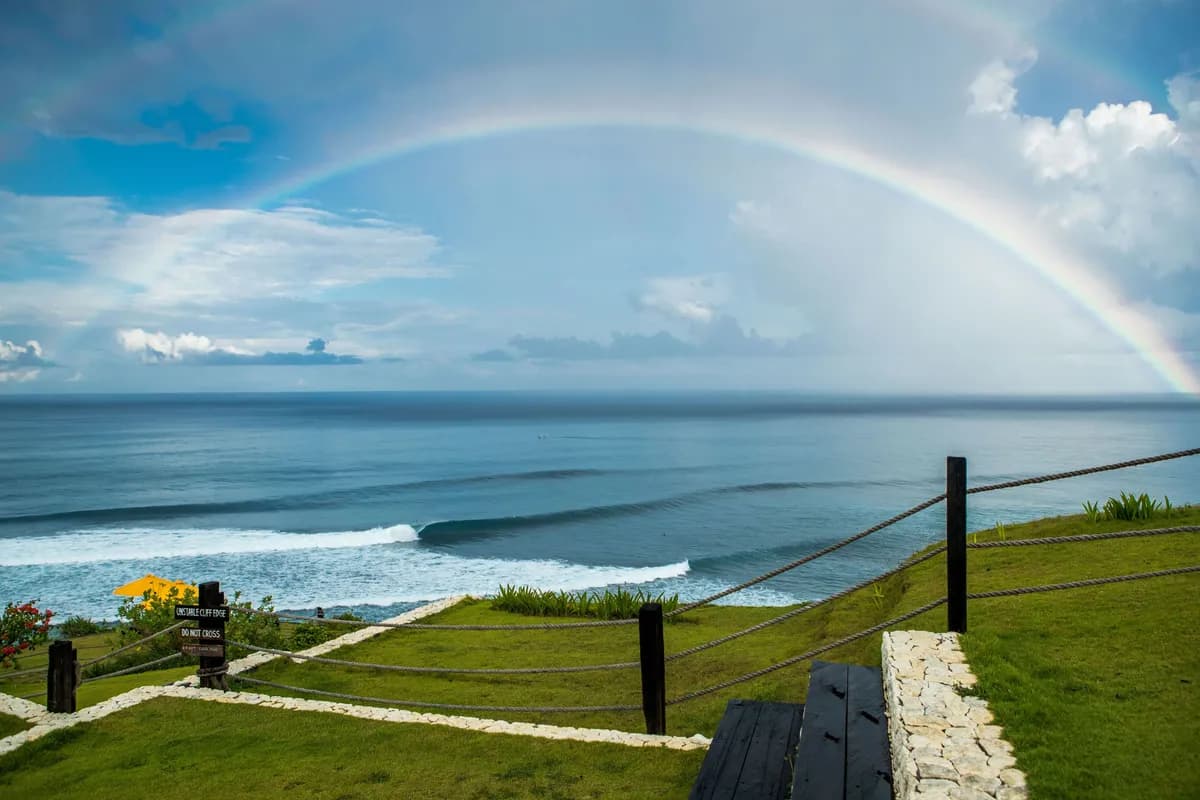
Photo: Sweet Ice Cream Photography sweeticecreamphotography · CC0 · via Wikimedia Commons
Uluwatu
The defining wave of Indonesian surfing. Five connected peaks (Temples, The Peak, Race Track, Outside Corner, The Bommie) that line up for hundreds of metres on the right swell.
Surf outlook
our estimate (what does this mean?)
A 1-5 score of how organised the waves look, from forecast height, period and wind speed — it rates the waves, not whether they fit your ability.Sunrise around 06:02, sunset around 18:14 today.
- Today2.1–2.2mSSW12s· 19km/h
- Mon1.9–2.1mSSW11s· 18km/h
- Tue2.0–2.0mSSW12s· 19km/h
- Wed2.1–2.1mSSW12s· 16km/h
- Thu2.1–2.3mSSW13s· 14km/h
- Fri2.3–2.4mSSW13s· 15km/h
- Sat2.1–2.1mSSW13s· 12km/h
mean sea level (what does this mean?)
The long-run average height of the sea surface — tide heights are metres above (+) or below (−) that average.Times on this card are local to Uluwatu. The star call is our own estimate, calculated from the forecast height, period and wind speed — not measured, and not a suitability or safety assessment. How we rate explains the scale. Weather data by Open-Meteo.com, licensed CC BY 4.0. Fetched .
Live conditions
Period (what does this mean?)
Time between waves. Longer period = more powerful, better-organised waves.Swell (what does this mean?)
Waves made by distant storms, smoother and more ordered than the choppy waves a local wind whips up.Wind (what does this mean?)
Offshore wind (land to sea) holds waves up and smooths their faces; onshore wind (sea to land) makes them crumble and close out sooner.Estimated wave energy (what does this mean?)
How much power each metre of wave front carries (kW/m), worked out from height and period — higher numbers mean waves that push harder.Calculated by us from the height and period above, not measured — and it describes the swell offshore, not the wave at the break.
Waves from DWD Global WAM, wind from ECMWF IFS, for a model grid point 12 km from the break. Fetched . Times on this card are local to Uluwatu. Weather data by Open-Meteo.com, licensed CC BY 4.0. Not a suitability or safety assessment — check local conditions and ask your instructor.
Surf Snapshot
Estimated seasonal guidance — not a live forecast.
When to surf Uluwatu, month by month
Estimated from our authored seasonality — not a live forecast.
Peak season: May, Jun, July, Aug, Sept (All-time).
| Month | Surf consistency | Wetsuit |
|---|---|---|
| Jan | Inconsistent | Boardshorts |
| Feb | Inconsistent | Boardshorts |
| Mar | Moderate | Boardshorts |
| Apr | High | Boardshorts |
| Maypeak | All-time | Boardshorts |
| Junpeak | All-time | Boardshorts |
| Julypeak | All-time | Boardshorts |
| Augpeak | All-time | Boardshorts |
| Septpeak | All-time | Boardshorts |
| Oct | High | Boardshorts |
| Nov | Moderate | Boardshorts |
| Dec | Inconsistent | Boardshorts |
Does this wave fit your level?
Rated for Levels 5-7 · Best at Level 6.
Take the 2-minute quiz to see if Uluwatu fits you today.
Find my Level →Beginner notes
Entry and exit through a cave at the cliff. Not viable below Level 5. Don't paddle out without watching at least one tide cycle.
Hazards
- shallow reef
- urchins
- cave entry
- crowd
Camps near Uluwatu


Nearby spots
The closest graded spots to Uluwatu, straight-line distance.
- Padang Padang~2 km · Levels 6-7
- Canggu (Batu Bolong)~18 km · Levels 2-5
- Medewi~53 km · Levels 3-6
Best months to surf here
In-season months for Bali, from our editors’ season calendar.
How this spot is sourced
Cross-checked against 5 sources from 2 independent lineages, last checked June 2026.
Two or more independent sources agree on best swell direction, best wind direction, bottom, wave type, which way it breaks and exact position.