

Ask a room full of surfers what level they are and most will say “intermediate.” It's the most useless word in surfing — it covers someone who stood up for the first time last Tuesday and someone throwing cutbacks on a head-high point. Camps know it too, which is why so many reach for the same phrase: “all levels welcome.”
By Joe Kim — I've been surfing 10+ years, mostly on trips since I'm originally from Canada. I'd call myself a solid Level 5 intermediate who still has a lot to learn.
That vagueness has a real cost, and you pay it. Book a trip that's over your head and you spend the week sitting in the channel watching — or worse, getting worked on a reef you had no business paddling out to. Book one that's beneath you and you're stuck on a foamie in the whitewater when you came to actually progress. A surf trip is a lot of money and a precious week off. The wave has to match the surfer, and “beginner / intermediate / advanced” is too blunt an instrument to make that match.
I once booked an “all-levels” camp in the Canary Islands expecting it to be surf-first. It wasn't. The earliest we ever paddled out was 9am, and because I happened to be the most advanced surfer there, I got taken to spots pitched at the beginners and novices who made up the average group. It was frustrating: I'd paid good money expecting shots at better breaks, but since every spot was a drive away, trading up was never an option.
So we built something more precise. We grade every surfer, every spot, and every camp on the same 1–7 scale — and we anchor each level to waves you can actually picture.
The progression, end to end
Every level is one checkable step past the last. Nothing here is about where you have surfed — only what you can do on a wave.
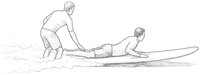
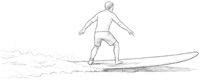
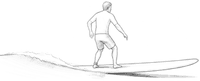
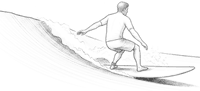
The checkpoints
These are the quiz's rungs, in order — and they are the whole ladder. Each one names the conditions it is judged in, because “catch an unbroken wave” means nothing until you say how big and how busy. They build on each other, so the quiz asks for one answer: the highest rung that's true most times you try. Everything below it is included, and shown to you as included — one tap claims all of it, so you should be able to see what you just said.
- 1→ Level 1None of these yetYou haven't stood up and ridden a wave on your own
- 2→ Level 2Pop up in white water and ride it in, unaidedBroken waves, no push, on a board that floats you
- 3→ Level 3Get yourself out to the line-up, and catch an unbroken wave and ride it straightWaist-to-chest-high, uncrowded, no rip running — turtle roll or duck dive, and paddling in yourself
- 4→ Level 4Angle the take-off and draw a line right or leftWaist-to-chest-high, uncrowded, choosing before you stand
- 5→ Level 5Make the drop and trim down the line without stallingChest-to-head-high, on most waves you go for
- 6→ Level 6Bottom turn with drive, and link it into a turn on the faceChest-to-head-high — cutback, top turn or floater, with control
- 7→ Level 7Link manoeuvres at speed on a wave of consequenceWater that punishes mistakes — and you judge entry and exit yourself
Level 1 has no checkpoint. Nothing is assumed, so there is nothing to claim.
Two axes, not one
What you can do on a wave, from the checkpoints above. This is the number the whole directory speaks: a spot rated Levels 3–5 is rated against this scale.
Reef or rock bottom, overhead surf, a crowded line-up. Three things you have either surfed independently and more than once, or you haven't.
These never move your level. Having only ever surfed sand doesn't make you a worse surfer — it makes a reef new to you, which is a different thing and worth saying separately.
The question is deliberately “have you surfed this?” rather than “are you comfortable with it?” Comfort is a feeling and it inflates. Repetition is a fact.
The seven levels
Here's the whole system. The trick that makes it travel: each level is pinned to a concrete benchmark — usually a named, recognizable wave — not an adjective. “Level 4” points to the same kind of wave in Portugal as in Bali, in a way “intermediate” never could — even if the swell, the tide and the board under your feet still shape the actual day.
The quick version. If you just want to place yourself, the seven levels group into three broad bands — the same ones the directory's filters use. The band helps you find yourself; the numbered level underneath is what we actually match a wave to. So “somewhere between beginner and intermediate” isn't a missing rung — it's Level 3, near the top of the beginner band.
From your first whitewater ride to catching your first green waves. Foamies, patient coaching, gentle beach breaks.
Catching green waves on your own and starting to turn — trading the foamie for a real board and reading the ocean.
At home in powerful, overhead surf — reefs, points, crowds and real consequence.
First Timer
New to surfing or only tried once. Needs full instruction.
- Nothing assumed — everyone starts here
- Swimming and floating comfortably in moving water
- Water safety: rips, depth, where not to be
- Board control — never between you and anyone else
- Paddling, popping up, and etiquette before you need it
Anchor: Soft top in whitewater under a watchful coach. Day one of your trip.
Whitewater Beginner
Can pop up and ride broken waves toward shore on a soft-top.
- Pop up in white water and ride it in, unaided
- Handle the board in the shallows without losing it
- Falling well — protect your head, breathe, wait it out
- Getting out through waves — turtle roll or duck dive, whichever your board needs
- Timing the paddle-out, and finding the safe route
- A proper stance: moving your weight without losing balance
Anchor: Waikiki on a small day. Banana Beach inside.
Green-Wave Beginner
Starting to catch unbroken waves and ride sideways down the face.
- Get yourself out to the line-up
- Catch an unbroken wave and ride it straight
- Positioning — where to sit, and when to move
- Wave selection: reading a shoulder, avoiding closeouts
- Paddling and timing into unbroken waves
- Angling the take-off instead of going straight
Anchor: Cowell's, Santa Cruz on a 2 ft day. Foz do Lizandro waist-high.
Intermediate
Catches green waves independently and rides both directions with basic control.
- Paddle out through the break
- Paddle into unbroken waves without a push
- Angle the take-off instead of going straight
- Draw a line right or left along the face
- Wave reading — where it will break, and when
- Predicting which way it peels, and how fast
- Trimming: stance for accelerating and slowing down
- Right of way — who's on the wave, and choosing your shoulder
Anchor: Ericeira beach breaks on a clean 3 ft day. Weligama outside.
Advanced Intermediate
Reads waves, generates speed, and links basic turns.
- Make the drop consistently, on most waves you go for
- Trim down the line without stalling
- Pick the peel direction before you commit
- Generating your own speed — pumping down the line
- Positioning yourself deeper, closer to the peak
- The bottom turn
- First cutbacks and top turns, on small clean waves
Anchor: Uluwatu on a clean 3-4 ft day. Nosara on a head-high day.
Advanced
Turns off the bottom with drive, links it into a turn on the face, and makes the critical section.
- Bottom turn with control and drive
- Link it into a turn on the face — cutback, top turn or floater
- Make a critical section rather than pulling out of it
- Choosing the manoeuvre the wave is asking for
- Carrying those turns into steeper, faster sections
- Reading a wave far enough ahead to set up
- Carving — full rail, at speed
Anchor: Pipeline on a 4 ft day. Bingin on a 5 ft day. Anchor Point overhead.
Expert
Comfortable in powerful, consequential surf and highly independent.
- Link manoeuvres at speed on a wave of consequence
- Judge your own entry, exit and wave selection without help
- Keep control when it goes wrong — and help someone else
- A specialism, whichever yours is
- Performance: snaps, barrels, fins-free, airs
- Or size, or glide — big-wave and longboard mastery count
- Whichever wave is currently beating you
Anchor: Pipeline at 8 ft+. Padang on a real swell. Teahupoo. Mavericks.
Several of these anchor waves have full spot pages in the directory: Foz do Lizandro, Uluwatu, Nosara and Anchor Point.
Why seven levels, and not three
Because three buckets hide the single most important line in all of surfing: the jump from riding whitewater (Level 2) to catching an unbroken green wave (Level 3) to actually controlling it down the line (Level 4). Those are three completely different surfers, on three different trips, needing three different camps and three different waves. Call all of them “beginner” and you've erased the exact distinction that decides whether a week of lessons works.
The same collapse happens at the top. “Advanced” lumps a surfer who's comfortable on a head-high beach break together with one who paddles out at Pipeline. Levels 5, 6, and 7 pull those apart — and the gap between them isn't pride, it's the difference between a great week and a trip to the clinic.
The honesty problem (and how the score handles it)
There's a catch with any self-rating system: everyone overrates themselves. So the rung you pick isn't the last word. Beside it sits a Surf Fit Score (0–100), built from four things you answer separately from the ladder — the biggest wave you actually surf on a normal day, how many times you've surfed in your life, the boards you're comfortable on, and your ocean safety and etiquette. You get the lower of the two, and if they disagree by much, we say so rather than quietly marking you down.
Those four are deliberately the whole list. The score used to include the manoeuvres you can do — but those were worked out from the ladder, so the score was partly checking the ladder against itself. Taking them out is what makes the second opinion an actual second opinion.
One thing is measured and deliberately not scored: how often you surf at the moment. Rusty isn't the same as unskilled. If you've been out of the water a while we'll say your first sessions back will feel like less than your level — we won't take the level away.
And it has plausibility guards. Say you pick a rung that involves standing in barrels, but the biggest wave you've honestly surfed is knee-high — the score caps you, because those two things don't coexist. Claim a high rung on a handful of sessions and it won't take that at face value either: it caps the score and tells you the two answers disagree. This isn't gatekeeping; it's the opposite. A level is only useful if it actually predicts whether a given wave will work for you. An honest number is the entire point.
This one's personal for me. I want camps to be honest about what they actually offer, so people aren't misled and get the experience they paid for. If a camp calls itself surf-first, it should be surf-first — and it should be straight about what the coaching is really like and what conditions you can realistically expect.
How to use it to pick a trip
Every spot in the directory carries three numbers, not one:
- Minimum safe. Below this level, the wave is more than you should be taking on.
- Best progression. The level this wave pushes forward the fastest.
- Maximum challenge. Above this, the wave stops teaching you anything.
Each camp is graded for the range of waves it sits on. Match your level against that range and you get a straight answer: great fit (you'll progress here), push yourself (in range but at the edge — pick the lighter days), not yet (build up somewhere else first), or below your level (you'll outgrow it by Wednesday). No marketing, just the fit.
Take the 2-minute quiz to find your level, then filter the whole directory by it in where to surf or discover.
What 329 hand-checked camps actually look like
One thing the level system surfaces that you can't see from any individual camp's marketing: the surf-camp market is overwhelmingly built for the beginner-to-intermediate journey.
The takeaway is practical. If you're early in the journey, you have an enormous field to choose from and the only question is fit. If you're Level 5 or up, the field narrows fast — and a precise level becomes the difference between booking a camp that actually has a wave for you and one that quietly doesn't.
Find your level
Your Surf Level is the single most useful thing to know before you book a surf trip — more than the price, the photos, or the Instagram. It takes about two minutes to find out, and then every camp and spot on the site sorts itself against you automatically.
Take the 2-minute Surf Fit quiz to find your level and score. For the full mechanics behind the rating, see how we rate.